Most finance leaders can name their ERP vendor without thinking.
Far fewer can explain how the whole thing actually fits together, and that gap is where a lot of expensive transformation programs fall apart.
What keeps finance leaders up at night isn’t which system runs the ledger. It’s four questions: how fast do we close, can we trust the forecast, will the audit be clean, and what is finance costing us to run?
So here’s how I’d map the finance tech landscape, by outcome rather than by logo:
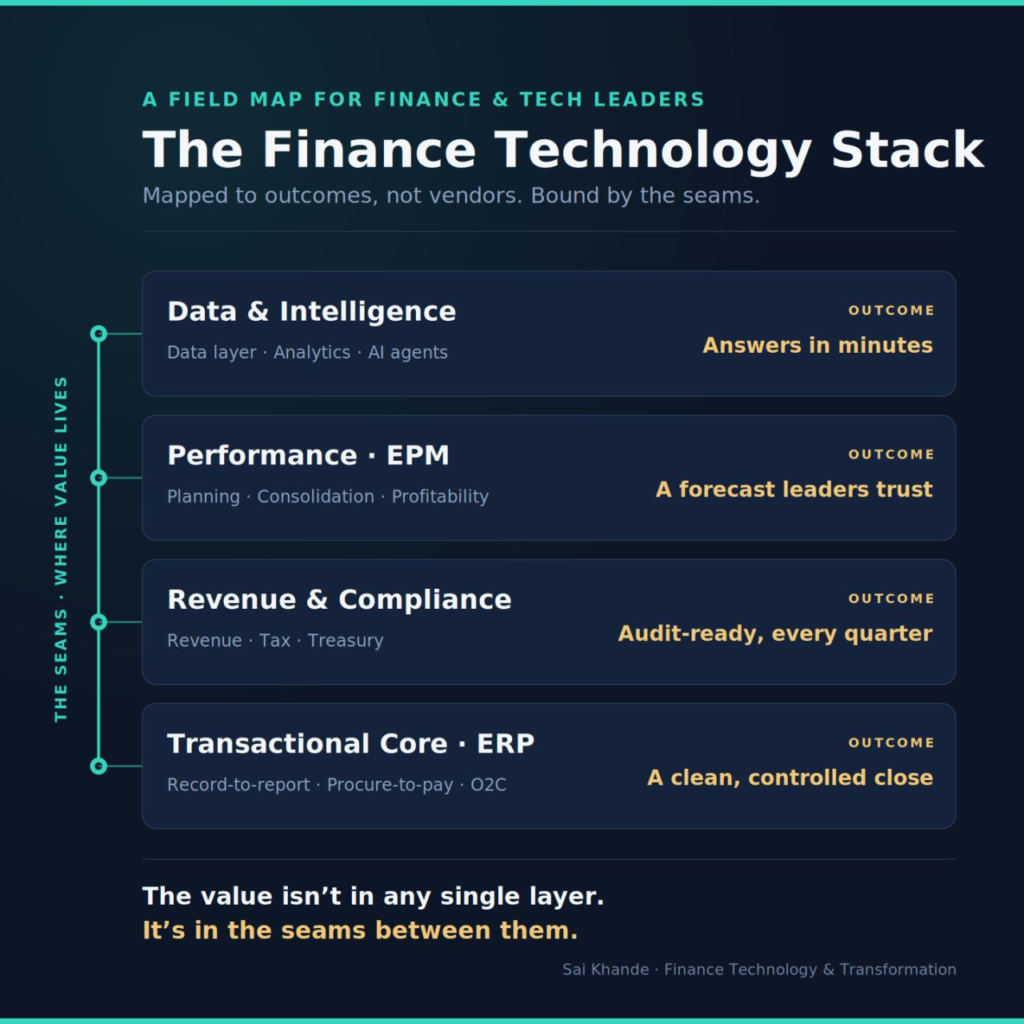
ERP, the transactional core (record-to-report, procure-to-pay, order-to-cash): a clean, controlled close.
EPM, the performance layer (planning, consolidation, profitability): a forecast leadership will actually believe.
Revenue and compliance (revenue, tax, treasury): audit-ready every quarter instead of scrambling.
Data and intelligence (the data layer, analytics, and now AI agents): answers in minutes, not at month-end.
And the part nobody puts on a roadmap: the connective tissue. Integration, master data, controls.
The pattern I keep seeing: teams buy the best tool for each box. Great ERP, a separate planning tool, a point solution for revenue. Each one is excellent alone. But they don’t talk, so someone is still stitching spreadsheets together at 11pm to make the numbers line up.
The value was never in any single box. It lives in the gaps between them, and somebody has to own those gaps.
That’s the difference between running finance systems and leading a finance transformation..